Menstrual Migraines: Timing Patterns, Triggers, and What to Track
When headaches follow your cycle, your tracker becomes a powerful clue
Menstrual migraines are not “just bad headaches.” They often follow a repeatable timing pattern around your period, can feel more intense than migraines at other times, and tracking can make them easier to predict and discuss with a clinician.
If you notice migraine attacks that reliably show up before or during your period, you’re not alone. Hormone changes across the cycle can influence migraine susceptibility, and many people find that the days around menstruation are the most consistent “trigger window.”
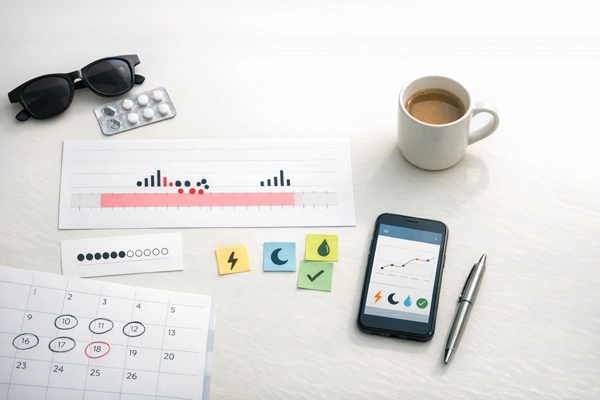
Cycletrack can help you connect the dots by logging period days, symptoms, and a simple headache diary in one place. The goal is not to diagnose yourself — it’s to identify patterns and arrive at appointments with clear, concrete information.
What is a menstrual migraine (and when does it happen)?
Menstrual migraine is commonly described as migraine attacks that start in a specific time window: around two days before your period begins through the first three days of bleeding. Some people have migraine only in this window (“pure” menstrual migraine), while others also have migraines at other times of the month (“menstrually-related” migraine).
This timing matters because it turns “random attacks” into a predictable pattern. If your migraine repeats in at least two out of three cycles, tracking can help you confirm the link and plan ahead.
Why migraines cluster around your period
A leading explanation is estrogen withdrawal — estrogen levels naturally fall in the days leading up to menstruation. For some people, that drop increases migraine risk. Other period-related factors (like prostaglandins, sleep disruption from cramps, or changes in appetite) may also contribute.
The important takeaway: your migraine is real, and it’s not “all in your head.” Timing and context are valuable signals.
How menstrual migraines can feel different
Many people report that menstrual migraines are harder hitting than their non-menstrual attacks. They may be longer-lasting, more intense, or more resistant to usual relief strategies. You may also notice stronger nausea, light sensitivity, or sound sensitivity.
That’s why tracking severity and impact (not just “yes/no headache”) is so helpful. It shows the true burden.
Common triggers that stack on top of hormones
Hormone shifts can set the stage, but other triggers often “pile on.” Everyone’s trigger mix is different, so your goal is to identify your personal pattern.
- Stress and fatigue: intense weeks, emotional stress, burnout.
- Poor sleep: shorter sleep, broken sleep, insomnia around PMS.
- Skipping meals: irregular eating, low blood sugar, long gaps between meals.
- Caffeine changes: sudden increase or sudden reduction.
- Dehydration: especially if bleeding is heavy or you’re not drinking enough.
- Alcohol: can be a strong trigger for some people.
- Neck/jaw tension: clenching, posture strain, long screen days.
- Other period symptoms: cramps, nausea, and mood changes that disrupt routine.
Tracking helps you see whether migraines appear only with hormone timing or whether they need an extra “push” (like stress + poor sleep).
What to track (the menstrual migraine checklist)
You don’t need a complicated system. If you track these items consistently, you’ll get most of the benefit:
- Cycle timing: period start date, and the cycle day when the migraine began (e.g., “day -1” or “day 2 of bleeding”).
- Headache start/end: time of onset, duration, and whether it peaked quickly or built up.
- Severity (0-10): and add one line about impact (“missed work,” “couldn’t sleep,” “needed a dark room”).
- Symptoms: nausea, vomiting, light sensitivity, sound sensitivity, dizziness.
- Aura (if present): visual changes, tingling, speech changes — and how long it lasted.
- Medication: what you took, when you took it, and whether it helped (partial/full/no relief).
- Sleep: hours and quality the night before.
- Food and hydration: skipped meals, dehydration, alcohol, unusual caffeine.
- Stress and activity: high stress day, travel, intense workout, long screen time.
Practical tip: If tracking everything feels like too much, start with timing + severity + medication. Add triggers later once it becomes routine.
How to spot your pattern (simple examples)
- Predictable window: migraines arrive on day -1 and day 1 of bleeding in most cycles → strong menstrual link.
- Stress amplifier: mild migraine pre-period in calm months, severe migraine when stress/sleep is worse → stacked triggers.
- Aura pattern: aura only appears around the period window → valuable detail for a clinician.
- Medication timing: relief improves when meds are taken early → helpful insight for planning.
After tracking for 2-3 cycles, you’ll usually see whether attacks cluster around the same days or shift with life circumstances.
What to bring to a medical appointment
If you’re seeking support, bring a summary that’s easy to review:
- How many migraine days per month (and how many are in the period window).
- Your typical timing (e.g., day -2 to day 2).
- Your most common symptoms and whether aura occurs.
- What you’ve tried and what worked/didn’t work.
- Impact (missed work/school, sleep disruption, inability to function).
This turns a stressful conversation into a structured one — and helps clinicians choose options that fit your pattern.
When to seek medical advice (and when to seek urgent help)
Consider speaking with a healthcare professional if your migraines are severe, getting worse, happening more than once a week, difficult to control, or regularly linked to your period. Seek urgent help if a headache is sudden and extremely severe, if you have new neurological symptoms (like trouble speaking, weakness, confusion), vision loss, or a prolonged aura.
Why Cycletrack is a good fit for menstrual migraine tracking
- Cycle + symptoms together: link migraine days to bleeding, PMS, ovulation signs, and stress notes.
- Symptom-focused: severity, triggers, medication timing, and impact in one place.
- Private by design: your health logs stay on your device unless you choose to sync.
Note: this content is educational and not a substitute for medical advice.
Get Cycletrack
Private, simple cycle tracking — free, no ads.
— MIRO PERDOCH, creator of Cycletrack
Support Cycletrack (optional)
If Cycletrack is useful to you, you can support the project with a donation. Donations help me keep the app free, maintain it long-term, and continue writing educational articles that help users understand their cycle and related conditions.
→ Support Cycletrack by donation