
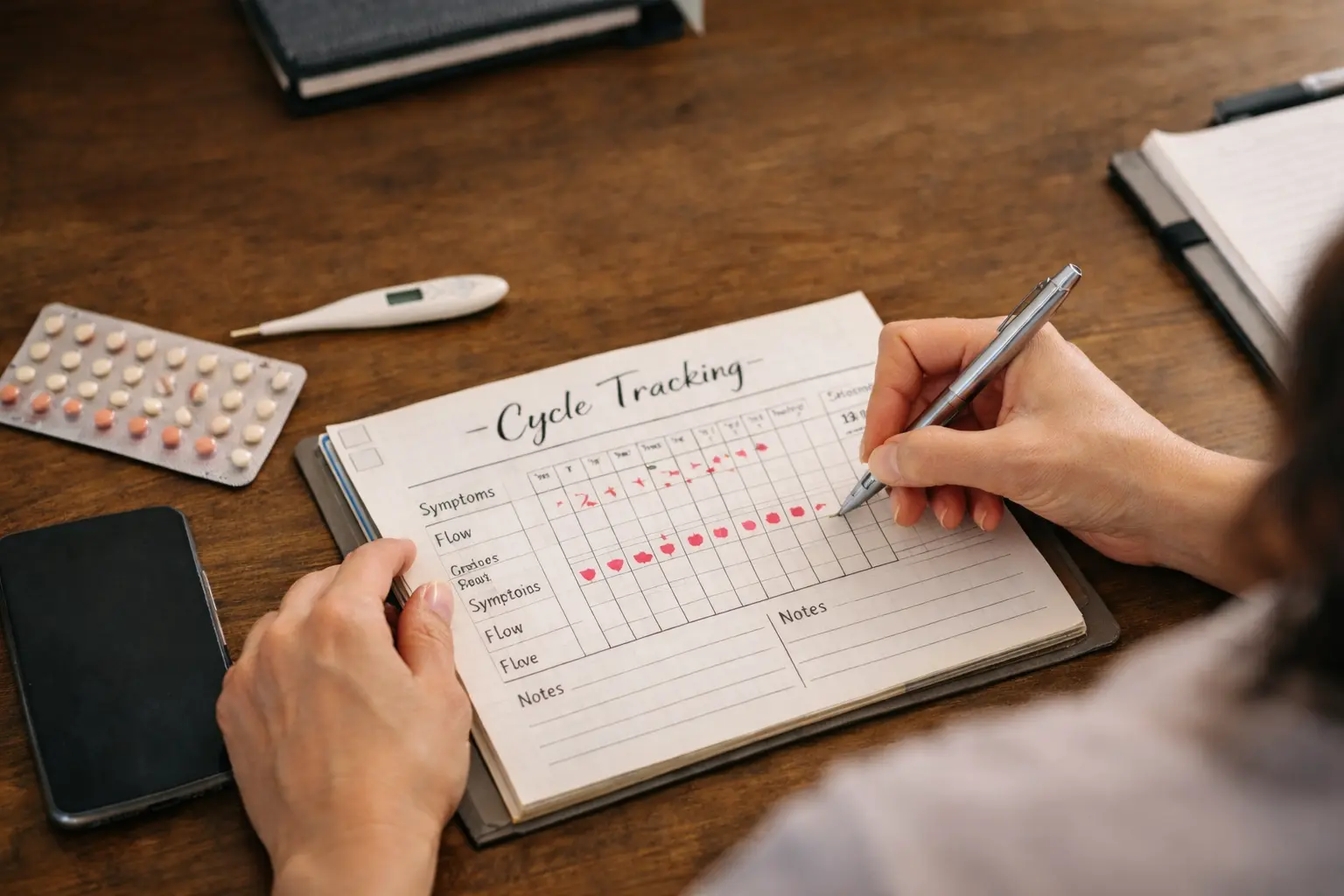
If your doctor asked about the last 3 months, could you answer clearly?
Why clear cycle records can make doctor visits more useful
When a doctor asks, “What have the last 3 months been like?” many people suddenly realize how difficult that question really is. Dates blur. Symptoms overlap. And details that felt obvious at the time can become hard to explain later.
This is one of the clearest reasons to track your cycle. Not because you need a perfect record, but because a simple timeline can help you describe what happened with much more confidence and accuracy.
Without notes, it is easy to rely on rough impressions: “my periods have been strange,” “I think the pain is getting worse,” or “I had spotting recently.” But during a medical appointment, the more clearly you can describe timing, bleeding, pain, and repeated symptoms, the more useful that conversation can become.
Why doctors often ask about the last few months
A single cycle can look different for many reasons. Stress, illness, travel, sleep disruption, weight changes, intense exercise, and medication changes can all affect timing and symptoms. Looking at the last 2-3 cycles helps show whether something was likely a one-off event or part of a repeating pattern.
That matters because patterns are often more informative than isolated moments. Repeated severe cramps, increasingly heavy bleeding, frequent spotting, worsening headaches, or regular digestive symptoms around the same cycle phase may all be easier to notice when you have even basic records.
What is often hardest to remember accurately
When people try to answer from memory alone, these details are commonly unclear:
- Cycle length: whether the last three cycles were similar in length or noticeably different.
- Period timing: the actual start day, end day, and whether bleeding arrived earlier or later than expected.
- Flow pattern: whether bleeding was light, moderate, heavy, included clots, or changed suddenly.
- Pain pattern: whether cramps started before bleeding, during bleeding, around ovulation, or outside the usual cycle pattern.
- Spotting: whether it happened before the period, after the period, mid-cycle, or after sex.
- Associated symptoms: headaches, migraines, bloating, nausea, diarrhea, constipation, fatigue, dizziness, low mood, irritability, breast tenderness, acne, or pelvic pain.
- Severity: whether symptoms were mild, moderate, severe, or strong enough to affect work, school, sleep, or normal daily activity.
- Context: illness, new medication, major stress, disrupted sleep, travel, or lifestyle changes that may help explain a difference.
Each of these details can sound minor on its own. Together, they can help turn a vague complaint into a much clearer health picture.
Why memory can distort the pattern
Most people remember the most painful day, the most recent cycle, or the month that felt unusually stressful. That is normal. But it can also hide the larger pattern.
For example, someone may feel that their period is “always late,” while their notes show one delayed cycle surrounded by otherwise regular timing. Someone else may think pain happens randomly, while tracking shows it consistently peaks on the first two bleeding days or around ovulation. These differences matter when you are trying to describe symptoms clearly.
What to track if you want better answers
You do not need an overly detailed system. A simple and realistic approach is often the most sustainable. Try tracking:
- Period start and end dates
- Daily flow level such as spotting, light, moderate, or heavy
- A small set of symptoms that matter most to you
- Short notes when something feels different, worse, or unusual
For many people, the most useful symptoms to track are cramps, pelvic pain, headaches, bloating, mood changes, breast tenderness, fatigue, digestive changes, and spotting. You do not need to track everything — just enough to notice whether something repeats.
How simple tracking can improve a medical appointment
When you have even a basic record, your answers become much more specific.
Instead of saying:
- “My cycle has been a bit irregular.”
- “I’ve had some pain lately.”
- “The bleeding might be heavier than before.”
You may be able to say:
- “My last three cycles were 26, 34, and 29 days.”
- “I had spotting 2 days before the period in two of the last three months.”
- “Pain was strongest on day 1 and day 2 of bleeding and once also mid-cycle.”
- “Heavy flow lasted 2 days and I felt unusually fatigued during the same time.”
That does not diagnose anything by itself, but it gives your doctor a clearer starting point and reduces the need to rely on guesswork.
Tracking is not about self-diagnosis
Tracking does not replace medical advice, testing, or examination. Its value is that it helps you notice patterns, describe symptoms more clearly, and remember what happened over time.
It can also help you tell the difference between “this month felt unusual” and “this has actually happened three cycles in a row.” That distinction can be very important.
Perfection is not required
One of the biggest mistakes people make is assuming that tracking only helps if they do it perfectly. In reality, partial records are often far better than trying to remember everything later during a stressful or rushed appointment.
Consistency matters more than complexity. A few taps a day, or a short note when something changes, can be enough to build a much clearer picture over 2-3 months.
When clearer records may be especially helpful
Keeping a clearer cycle record may be especially useful if you are experiencing:
- Very painful periods
- Heavy bleeding or bleeding that feels different from your normal pattern
- Frequent spotting between periods
- Worsening PMS or PMDD-like symptoms
- Headaches or migraines linked to certain cycle phases
- Pelvic pain outside your usual period days
- Sudden changes in cycle length
- Uncertainty about what is repeating and what is not
In situations like these, a simple log may help you feel more prepared and may support a more focused conversation with a healthcare professional.
A quick note about health advice
This article is educational and is not a substitute for medical advice. If you have severe pain, very heavy bleeding, fainting, sudden major changes, or symptoms that worry you, please seek advice from a qualified healthcare professional.
Clearer records can make difficult conversations easier
If your doctor asked about the last 3 months today, would you feel confident answering clearly? If not, that is completely understandable. Memory is often too limited for that kind of question.
A simple cycle tracker can help turn scattered memories into a clearer timeline of dates, bleeding, symptoms, and patterns. And sometimes that clarity is exactly what helps you feel more informed, more prepared, and more confident when talking about your health.
Get Cycletrack
Private, simple cycle tracking — free, no ads.
— MIRO PERDOCH, creator of Cycletrack
Support Cycletrack (optional)
If Cycletrack is useful to you, you can support the project with a donation. Donations help me keep the app free, maintain it long-term, and continue writing educational articles that help users understand their cycle and related conditions.
→ Support Cycletrack by donation